
Recasting Financial Communication: Why Human Judgment Is Moving Upstream
March 2026
In accounting, “recasting” financial statements means reorganizing numbers to better reflect economic reality. Adjustments are made. Categories are clarified. One-time distortions are removed. The goal isn’t to change the facts; it’s to present them in a way that more accurately reflects what they mean.
Financial firms face a similar challenge today. Not with numbers, but with systems.
As information becomes abundant and distribution becomes instantaneous, the real risk no longer lives in production. It lives in interpretation. That’s where human judgement and firms like mine operate, and it’s why we chose the name Recast Financial deliberately.
The Three Layers of Modern Financial Communication
Every financial communication system operates across three layers.
The first is information: data feeds, models, research notes, AI tools, portfolio analytics. The raw material used in content production.
The second is interpretation: human judgment, framing, regulatory awareness, and the determination of what a system is permitted to say and how it should say it.
The third is communication: the reports, market commentary, educational materials, client updates, and increasingly, AI agents that carry meaning to its final audience.
Automation is expanding rapidly in the first and third layers. AI can summarize research, draft updates, reformat content, and generate variants across channels at a scale no human team can match.
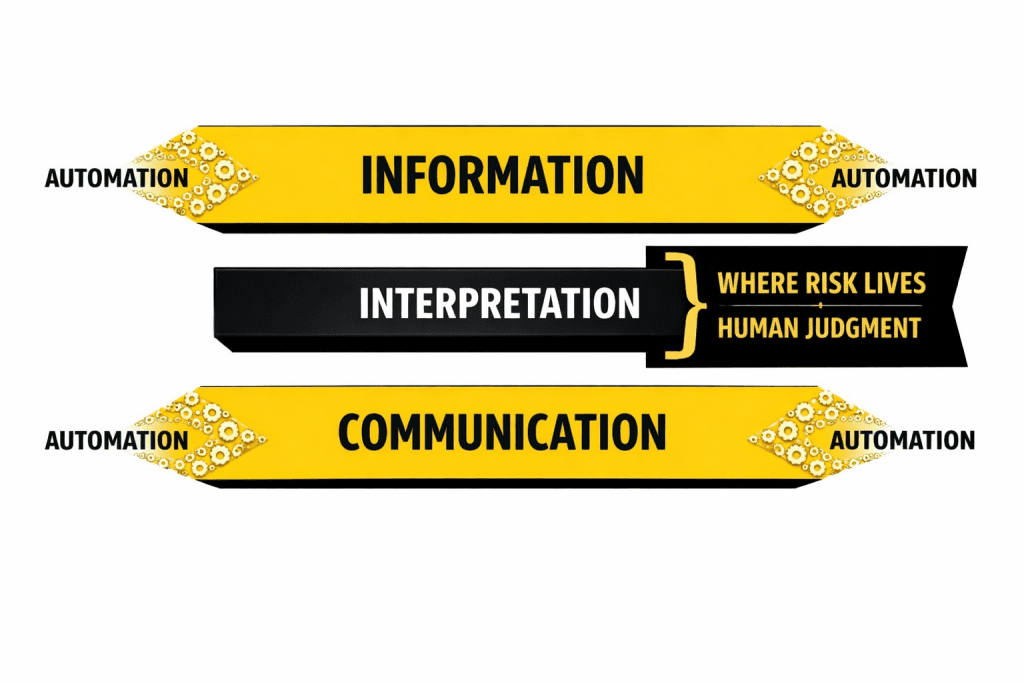
Where Risk Actually Lives
Most firms believe their risk sits in compliance or marketing. In reality, it often lives earlier and in deciding how automated systems produce meaning.
This is what is meant when we say, interpretation doesn’t disappear when automation arrives; it moves.
- Upstream into decisions about what data is used, what assumptions are encoded, and how outputs are structured before the system runs. This is often associated with governance.
- Downstream into review and approval processes that determine whether something is accurate, appropriate, and aligned with regulatory standards before it scales. This is often associated with compliance.
As automation increases, the interpretation layer becomes more valuable, not less.
Automated systems do more than generate content. They generate conclusions about markets, performance, risk, and strategy. Once distributed, that meaning becomes real. It shapes investor decisions, influences reputations, and attracts regulatory attention. The speed of distribution doesn’t change what the content means. It amplifies the consequences of getting the meaning wrong.
When interpretation is applied reactively (after publication, after confusion, after scrutiny) it’s often expensive. But when it’s built into the system upstream, it acts as leverage.
The difference between those two outcomes is rarely a technology problem. It’s almost always a governance problem.
Recasting Financial Communication
Traditional recasting adjusts financial statements to better reflect economic reality. Modern recasting adjusts financial communication systems to better govern meaning.
At Recast Financial, the work isn’t about generating more content; it’s about modernizing how existing expertise moves through an organization:
- Recovering value from legacy materials, structuring content for clearer review and reuse,
- aligning subject-matter expertise with compliance processes, and,
- designing workflows where automation supports human judgment rather than bypassing it.
AI can dramatically improve efficiency in drafting, formatting, and repurposing content. But AI doesn’t determine what matters. It doesn’t absorb regulatory risk. It doesn’t understand fiduciary nuance. That responsibility remains human.
The difference today is that the consequences of getting it wrong scale much faster than they used to.
The Layer That Matters Most
As financial systems become more automated and higher-distribution, the most valuable work shifts away from production and toward the governance of meaning.
That’s the interpretation layer, and it’s where experienced human judgment becomes harder to replace, not easier.
Bottom Line
Recasting financial statements clarifies numbers.
Recasting financial communication systems clarifies how meaning is produced, reviewed, and distributed at scale.
That’s the focus of the work behind Recast Financial.
What the SEC Is Really Saying About AI…and Why It’s Bigger Than AI
February 2026
Brian Daly, Director of the Division of Investment Management at the SEC, recently spoke at the Investment Company Institute Winter Board Meeting about artificial intelligence and the future of investment management. (Here’s the link to the full text.)
While the commentary included AI adoption, liability concerns, and the need for collaboration between regulators and industry, the more important message ran deeper and wider.
What Daly described is not an AI-specific issue. It’s an industrywide pattern that shows up whenever automation replaces human execution. Let me explain.
Automation doesn’t remove judgment, but it often moves it.
Daly noted that earlier waves of financial automation, like quantitative models and algorithmic trading, eventually reached equilibrium through disclosures, controls, and accepted compliance practices.
That’s both true and instructive.
For instance, when algorithms replaced floor traders and market makers, human judgment didn’t disappear. It moved upstream. It moved from execution to infrastructure design; it moved from real-time decisions to assumptions, constraints, and oversight; it moved from “what just happened” to “what are we allowing the system to do.”
AI follows the same pattern but in different contexts and often at a larger scale.
The key difference is that modern AI systems are explicitly designed to remove humans from real-time loops. Humans remain involved, but in a more remote, supervisory role. That makes upstream interpretation (human judgment embedded in systems before automation) more important, not less.
Why “digitizing paper” isn’t the issue
Daly was especially blunt about disclosure modernization. Sending PDFs by email in 2026, he argued, isn’t innovation or groundbreaking; it’s digitizing paper.
His suggestion is for firms to use LLMs to help investors interact with disclosures, which highlights a real shift underway.

Once systems begin translating complex information directly for users, the central question becomes:
- Who decides what the system can say?
- What sources can it draw from?
- How are uncertainty and risk framed?
Those are interpretation decisions that require human judgement, not technical ones, and they happen before the LLM can generate a single sentence.
This is the pattern firms are beginning to recognize
Whether automation takes the form of algorithms replacing market makers, platforms standing in for editors, or AI systems interacting directly with investors, the pattern is the same.
As systems automate and scale, judgment doesn’t disappear; it moves upstream (and sometimes downstream). This judgment sits in the interpretation layer, where we make the most important editorial and compliance decisions, especially at large firms where content scales.
Firms that treat AI as just another efficiency tool risk learning this the hard way, after meaning has been imposed downstream by markets, regulators, or the public.
Daly’s remarks weren’t a mandate. They were a signal, and one the industry has encountered before.
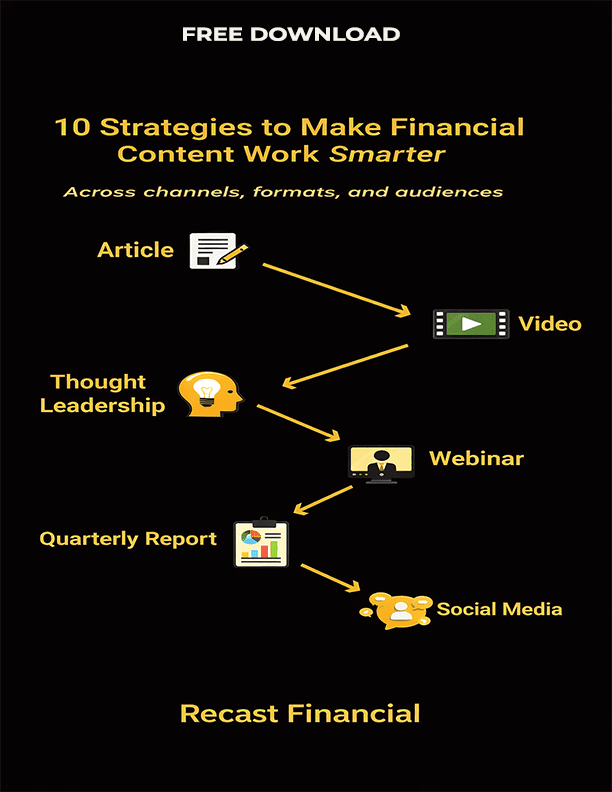
10 Content Strategy Ideas for the AI Era
Financial content works best when it can travel farther, reach new audiences, and be reused efficiently. This guide shows how financial firms can turn existing content—articles, videos, webinars, slide decks, FAQs, and internal materials—into scalable educational assets without starting from scratch.
Rather than creating more content, the focus is on repurposing what you already have into formats that align with how investors actually consume information today: visual, mobile-first, and on demand. The guide explores:
- How to transform static content into video, lead magnets, and funnels
- Ways to extend the life and reach of approved materials while staying compliant
- Why consistency and systems matter more than one-off campaigns
- How AI can support repurposing workflows without replacing human oversight
If your firm is sitting on valuable content that isn’t delivering the return it should, this resource provides a clear framework for turning those assets into something that scales—efficiently, predictably, and responsibly. The guide is a free download.
Under the hood of the latest firefly models
Many AI video creators want spectacular, realistic clips with dramatic motion, heavy camera moves, or entirely synthetic scenes. For professional content workflows, that’s often the wrong benchmark.
I wanted to show a more practical use case: taking a simple, static stock image and adding just enough motion to make it usable as background video, B-roll, or a transition.
Using Adobe Firefly as the interface, I ran the same image and text prompts through the third-party image-to-video models available within Firefly to compare cost, render time, and how closely each model followed restrained instructions.
The Project
If you already use Adobe Creative Cloud apps like Premiere Pro, After Effects, Photoshop, or Illustrator, you have access to Adobe Firefly and credits. Firefly acts as a front end to multiple third-party video models like Veo, Sora, and Runway allowing direct comparisons using identical inputs.
Before looking at results, it’s worth defining what’s being tested. This did not test text-to-image model. Instead, we looked at the image-to-video (i2v) model, which starts with a text prompt or still image (or both) and generates a short video clip by predicting how elements in that image might move over time. Instead of inventing an entire scene, the model extrapolates motion—fog drifting, lights blinking, subtle camera movement—based on both the image and a text prompt.
For this test, the reference image was a free Adobe Stock photo of a vintage movie camera in light fog. The text prompt was intentionally conservative:
“Very subtle, realistic motion only. Professional, restrained tone. The fog slowly lifts and dissipates. A small indicator light blinks on the camera body. All other elements remain still. No people, no dialogue, no text.”
We were most interested in how the models would animate only the fog as it lifts and dissipates, and add subtle blinking indicator lights on the camera. No new objects, no dramatic movement.
The Results
Using that same image and prompt, I tested Veo 3.1 from Google DeepMind, Sora 2 from OpenAI, Pika 2.2 from Pika Labs, Ray3 HDR from Luma AI, and Gen-4.5 from Runway.
Each model varied in cost, render time, and output quality. Some produced excellent atmospheric motion but ignored details. Others followed part of the prompt while introducing unexpected visual elements. A few delivered usable results quickly but at a higher credit cost.
The key difference wasn’t raw visual quality—it was how well each model handled restraint. You can see the actual video clips and other details in the accompanying video.
Summary
For professional content systems, the hardest thing isn’t creating motion, but it’s often knowing how little motion is enough. A simple text prompt and a sample image can go a long way.
These short, subtle clips can work well as transitions, background plates, or end-of-video visuals, especially when text or disclosures need to sit on top of motion without distraction.
When used thoughtfully, AI-generated video doesn’t have to be flashy to be valuable.
You can see how this longer video was repurposed into shorts on the YouTube channel.
AI + Financial Marketing
This ebook examines how educational content can become a powerful, compliant lead-generation engine—especially when supported by modern AI tools. As financial firms face increasing pressure to produce more content, faster, and at lower cost, artificial intelligence is reshaping how educational materials are created, reviewed, and distributed.
Inside the eBook, you’ll learn how AI can be responsibly integrated into content workflows without changing the rules—or increasing regulatory risk. The focus is not on shortcuts or automation for its own sake, but on building scalable, compliance-first content pipelines that help firms educate investors, build trust, and attract qualified prospects.
The guide explores:
- How AI fits into modern content development, from scripting to video and repurposing
- The key compliance considerations under SEC and FINRA rules when using AI
- Why transparency, disclosures, recordkeeping, and supervision matter more than ever
- How smaller firms can use AI-supported educational content to compete with larger institutions
Used correctly, educational content doesn’t just inform. It can position your firm as credible, professional, and trustworthy long before a sales conversation begins. This eBook provides a practical framework for doing exactly that, while staying aligned with regulatory expectations and investor protection standards. The accompanying video goes into more detail about using content as a lead-gen engine. The eBook is a free download.